Is board and train worth it in Austin?
Usually not for behavior problems. A dog trained in a facility learns to obey that trainer in that facility, then returns to a household that has not changed, and the behavior degrades. Brett Endes does not offer board and train at any price. He trains in your Austin home, or by Zoom, coaching the owner alongside the dog, from $295 for a 90 minute workshop. Call or text (512) 430-7953.
People ask me about board and train more than almost anything else, usually in the same breath as the words at my wits end. I understand the appeal completely. You are exhausted, the dog is a problem, and someone is offering to take the problem away for two weeks and hand it back solved. If that worked, I would run one.
It does not work, at least not the way it is sold, and I want to explain why in enough detail that you can make your own decision rather than take my word for it. I do not offer board and train at any price, so you should read this knowing my bias and then check it against what you see for yourself.
In thirty years and more than twenty thousand dogs, a large share of the hardest cases I have taken came to me after a board and train. Not because the trainers were frauds, many were skilled, but because the model asks a dog to learn obedience in one world and perform it in another.
Why the results do not come home with the dog
Dogs are context learners. A dog that learns to hold a down stay in a kennel run, on a slick concrete floor, with a professional handler and no distractions it cares about, has learned exactly that: how to behave in a kennel with that person. Your kitchen at dinner time, your front door when the delivery arrives, your street when another dog appears around the corner, none of that is in the lesson.
The second problem is bigger. Most behavior problems, and virtually all aggression and reactivity, are leadership and relationship problems as much as obedience problems. The dog behaves that way partly because of how the household runs. Send the dog away and the household does not change, so the conditions that produced the behavior are all still waiting when the dog gets back.
This is why the classic pattern goes: dog comes home noticeably better, the family is delighted for two to three weeks, and then it slides. That slide is not the dog being stubborn, and it is not the trainer having failed at the facility. It is context, plus a household that was never trained.
What I do instead, and why it holds
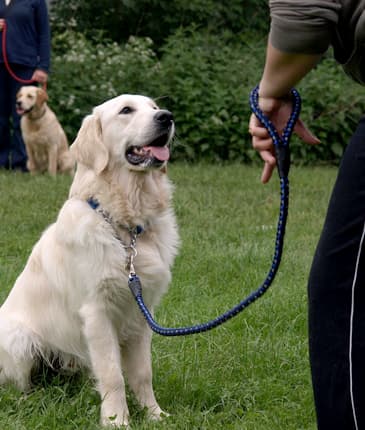
I train in your home, on your street, in the exact places the behavior happens, and I train you at the same time as the dog. That is not a soft version of training, it is the harder version, because you have to do the work. It is also the only version where the results still exist a year later.
The first session is a 90 minute in home workshop, $295, and most owners see a real change inside that session. From there, most behavior cases run the six lesson package at $1,495 or the ten lesson package at $1,995, which is the usual choice for the dogs other people have given up on. Same rate in your home or online, and every program includes lifetime phone, text and email support plus free lifetime drop in group classes at the Zilker Park meet up.
Compare that with what a two week board and train costs around Austin, and then compare what you own at the end. In one case you have paid for a dog that behaved somewhere else. In the other you have learned to run your own household, which is a skill that transfers to your next dog too.
If you are still considering one, ask these
Ask exactly how many hours per day your dog will be worked, and what happens the rest of the time. Some programs are excellent and some are a kennel with a training label on it, and the honest ones will tell you the number without flinching.
Ask what the transfer plan is. How many hours will they spend teaching you, in your home, after the dog comes back, and is that included. If the answer is one handover session in their parking lot, you now know what you are buying.
Ask what tools and methods they use and whether you can watch a session, unannounced, before you commit. And ask what happens if the dog comes home and regresses in month two, in writing. A confident program answers all four of those easily.
The cases where sending a dog away is genuinely tempting
There are real situations where owners cannot do the daily work: a medical crisis, a new baby arriving in weeks, a household where somebody is frightened of the dog right now. Those are legitimate and I take them seriously rather than lecturing people about commitment.
Even then, the fix is not usually a boot camp. It is a plan that meets the household where it is: more frequent sessions, tighter management of the environment while the humans get their footing, and honest sequencing about what changes first. I would rather tell you that in a free phone call than sell you two weeks of daycare.
The Austin specifics worth knowing
Around Austin the searches people use are board and train, dog boot camp, and sometimes kennel training, across Cedar Park, Round Rock, Lakeway, Georgetown, Leander and the Lake Travis area. The metro also has a jurisdiction wrinkle that matters if your dog is reactive: leash rules and enforcement change at city lines, and a dog trained to a facility standard has not been proofed against any of that. My guide to Austin metro leash laws lays out who governs what.
It also matters that your dog gets proofed in the places you actually go. A dog that is calm in a facility but comes apart on a shared trail with bikes, or at a busy park on a weekend, has not been trained for Austin, it has been trained for a building.